



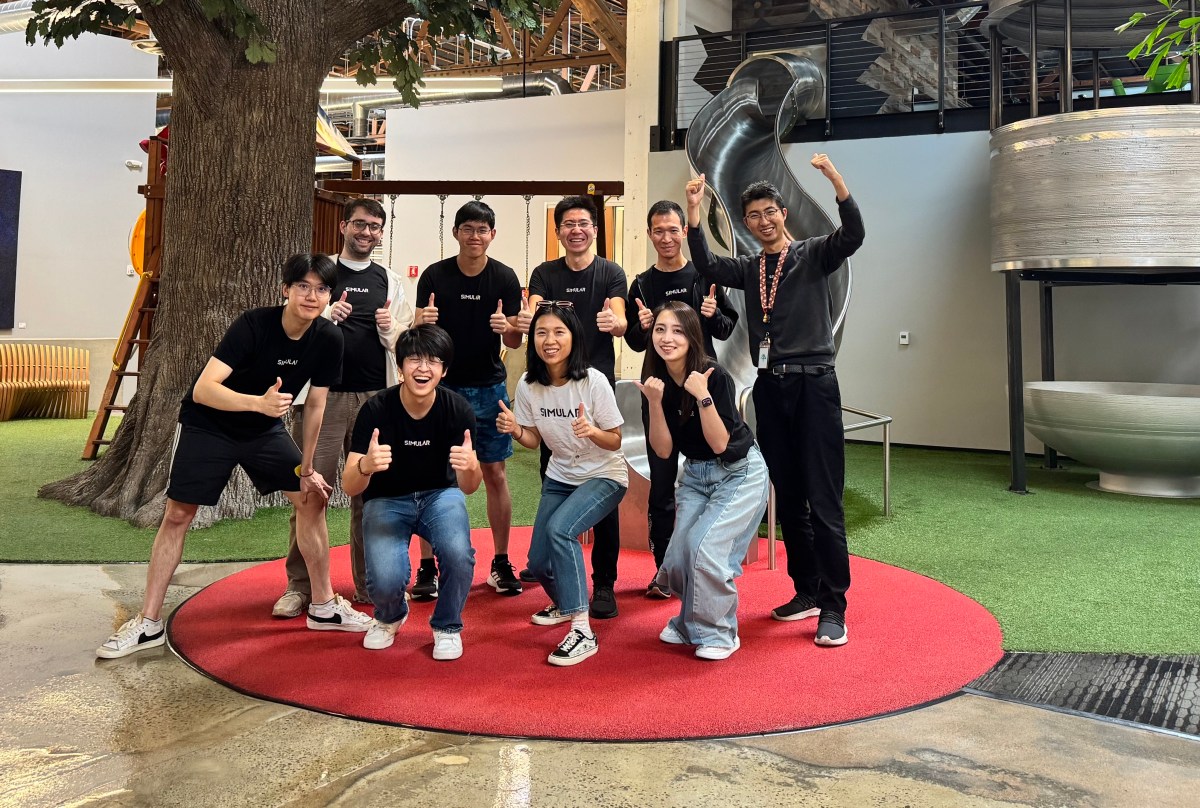
Simular, a startup developing AI agents for Mac OS and Windows, has raised $21.5 million in Series A led by Felicis, with participation from NVentures (NVIDIA's venture arm), existing seed investor South Park Commons, and others.
Simular is an interesting agent startup because, unlike other startups, it seeks to control the PC itself rather than the browser. (Agent AI refers to systems that can autonomously complete complex tasks with minimal human intervention.) “We can literally move a mouse and click on a screen, so we can repeat any human activity in the digital world,” co-founder and CEO Ang Lee told TechCrunch, citing the example of copying and pasting data into a spreadsheet.
On Monday, the company announced the release of version 1.0 for Mac OS. However, we are also working with Microsoft to develop agents for Windows. The startup is one of five agent companies accepted into the Windows 365 for Agents program that Microsoft announced in mid-November. (Others include Manus AI, Fellowu, Genspark, and TinyFish.) Li was vague about the timeline for the Windows version, other than to say it promises to be as popular or more popular than the Mac version.
Another reason to look at Simular is the integrity of its founders. Li is a continuous learning scientist who previously worked at Google's DeepMind, where he met co-founder Jiachen Yang, a reinforcement learning specialist. Although their team published a significant amount of papers, the research was not strictly academic, Lee said. It was intended to improve Google products, including Waymo.
A background in AI products is helpful, as there are many technical issues that need to be solved before Silicon Valley's dream of a future of agents becomes a reality. One of the biggest is that LLMs have a certain percentage of hallucinations.
Agent tasks can require thousands to millions of individual steps to be completed. Not only does hallucination in a single step nullify all of the agent's work, but hallucinations are statistically more likely to occur as the number of steps increases.
One way to solve this is to make the “non-deterministic” LLM “deterministic”. This means that instead of the LLM being endlessly creative, its responses and actions are scripted the same every time. But that risks limiting the entire creative problem-solving aspect of the agent.
tech crunch event
San Francisco | October 13-15, 2026
The simulator marries the two. The agent is free to repeat the task, with human users making corrections along the way, until the agent succeeds. A human then locks down the workflow for that task, making it more deterministic and reproducible.
“Our solution is to have the agent keep exploring success trajectories. Once we find a success trajectory, it becomes the definitive code,” Lee explains.
The startup is able to do this because its effort (which Li admits is still in its early stages) is not just an LLM wrapper that sends data to and retrieves data from the model.
“We have a new technology that no other agent company is using. We call it 'neuro-symbolic computer-assisted agents.' It's not completely LLM-based,” he said. “Our approach to solving the illusion is to have LLM write code that is deterministic, meaning that if you have a workflow that works, the next time you run that same workflow it will be just as successful.”
Another benefit is that this deterministic code that performs repeatable tasks is placed in the hands of the end user rather than the LLM. “Once you have the code, you can inspect it, audit it, see what's going on, so you can trust it,” Lee says.
Only time will tell if this method is the magic that will bring agency into the hands of every employee. Li said early beta customers include car dealerships that automate VIN number lookups and HOAs that extract contract information from PDFs. Additionally, the company's open source project (currently available only on Mac OS) enables automation from content creation to sales and marketing.
Simular previously raised $5 million in seed funding, bringing its total funding to approximately $27 million. Other investors in the company include Basis Set Ventures, Flying Fish Partners, Samsung NEXT, Xoogler Ventures, and podcaster and angel investor Lenny Rachitzky.