



President Donald Trump said he would make countering immigration one of his flagship policies during his second term in The White House, promising an unprecedented number of deportations.
A year in, data shows that deportations by Immigration and Customs Enforcement (ICE) and Customs and Border Protection have surpassed at least 350,000 people.
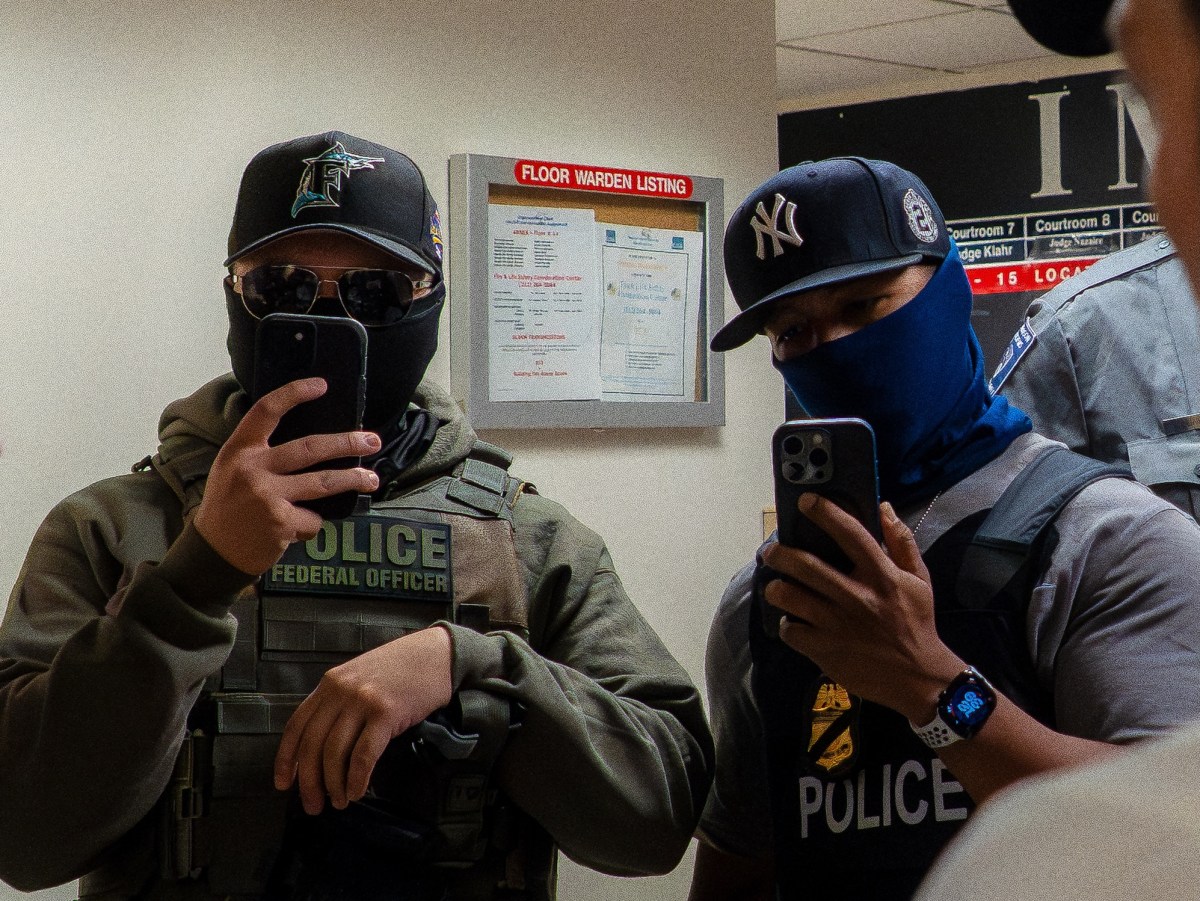
ICE has taken center stage in Trump’s mass removal campaign, raiding homes, workplaces, and public parks in search of undocumented people, prompting widespread protests and resistance from communities across the United States.
ICE uses several technologies to identify and surveil individuals. Homeland Security has also used the shadow of Trump’s deportations to challenge long-standing legal norms, including forcibly entering homes to arrest people without a judicial warrant, a move that legal experts say violates the Fourth Amendment protections against unreasonable searches and seizures.
Here are some of the technologies that ICE is relying on.
Cell-site simulators
ICE has a technology known as cell-site simulators to snoop on cellphones. These surveillance devices, as the name suggests, are designed to appear as a cellphone tower, tricking nearby phones to connect to them. Once that happens, the law enforcement authorities who are using the cell-site simulators can locate and identify the phones in their vicinity, and potentially intercept calls, text messages, and internet traffic.
Cell-site simulators are also known as “stingrays,” based on the brand name of one of the earliest versions of the technology, which was made by U.S. defense contractor Harris (now L3Harris); or IMSI catchers, a technology that can capture a nearby cell phone’s unique identifier which law enforcement can use for identifying the phone’s owner.
In the last two years, ICE has signed contracts for more than $1.5 million with a company called TechOps Specialty Vehicles (TOSV), which produces customized vans for law enforcement.
A contract worth more than $800,000 dated May 8, 2025 said TOSV will provide “Cell Site Simulator (CSS) Vehicles to support the Homeland Security Technical Operations program.”
TOSV president Jon Brianas told TechCrunch that the company does not manufacture the cell-site simulators, but rather integrates them “into our overall design of the vehicle.”
Cell-site simulators have long been controversial for several reasons.
These devices are designed to trick all nearby phones to connect to them, which means that by design they gather the data of many innocent people. Also, authorities have sometimes deployed them without first obtaining a warrant.
Authorities have also tried to keep their use of the technology secret in court, withholding information, and even accepting plea deals and dropping cases rather than disclose information about their use of cell-site simulators. In a court case in 2019 in Baltimore, it was revealed that prosecutors were instructed to drop cases rather than violate a non-disclosure agreement with the company that makes the devices.
Facial recognition
Clearview AI is perhaps the most well-known facial-recognition company today. For years, the company promised to be able to identify any face by searching through a large database of photos it had scraped from the internet.
On Monday, 404 Media reported that ICE has signed a contract with the company to support its law enforcement arm Homeland Security Investigations (HSI), “with capabilities of identifying victims and offenders in child sexual exploitation cases and assaults against law enforcement officers.”
According to a government procurement database, the contract signed last week is worth $3.75 million.
ICE has had other contracts with Clearview AI in the last couple of years. In September 2024, the agency purchased “forensic software” from the company, a deal worth $1.1 million. The year before, ICE paid Clearview AI nearly $800,000 for “facial recognition enterprise licenses.”
Clearview AI did not respond to a request for comment.
ICE is also using a facial recognition app called Mobile Fortify, which federal agents use to identify people on the street. The app relies on scanning a person’s driver’s license photo against 200 million photos, much of the data sourced from state driver’s license databases.
Paragon phone spyware
Contact Us
Do you have more information about ICE and the technology it uses? We would love to learn how this affects you. From a non-work device, you can contact Lorenzo Franceschi-Bicchierai securely on Signal at +1 917 257 1382, or via Telegram and Keybase @lorenzofb, or email. You also can contact TechCrunch via SecureDrop.
In September 2024, ICE signed a contract worth $2 million with Israeli spyware maker Paragon Solutions. Almost immediately, the Biden administration issued a “stop work order,” putting the contract under review to make sure it complied with an executive order on the government’s use of commercial spyware.
Because of that order, for nearly a year, the contract remained in limbo. Then, last week, the Trump administration lifted the stop work order, effectively reactivating the contract.
At this point, the status of Paragon’s relationship with ICE in practice is unclear.
The records entry from last week said that the contract with Paragon is for “a fully configured proprietary solution including license, hardware, warranty, maintenance, and training.” Practically speaking, unless the hardware installation and training were done last year, it may take some time for ICE to have Paragon’s system up and running.
It’s also unclear if the spyware will be used by ICE or HSI, an agency whose investigations are not limited to immigration, but also cover online child sexual exploitation, human trafficking, financial fraud, and more.
Paragon has long tried to portray itself as an “ethical” and responsible spyware maker, and now has to decide if it’s ethical to work with Trump’s ICE. A lot has happened to Paragon in the last year. In December, American private equity giant AE Industrial purchased Paragon, with a plan to merge it with cybersecurity company RedLattice, according to Israeli tech news site Calcalist.
In a sign that the merger may have taken place, when TechCrunch reached out to Paragon for comment on the reactivation of the ICE contract last week, we were referred to RedLattice’s new vice president of marketing and communications Jennifer Iras.
RedLattice’s Iras did not respond to a request for comment for this article, nor for last week’s article.
In the last few months, Paragon has been ensnared in a spyware scandal in Italy, where the government has been accused of spying on journalists and immigration activists. In response, Paragon cut ties with Italy’s intelligence agencies.
Phone hacking and unlocking technology
In mid-September, ICE’s law enforcement arm Homeland Security Investigations signed a contract with Magnet Forensics for $3 million.
This contract is specifically for software licenses so that HSI agents can “recover digital evidence, process multiple devices,” and “generate forensic reports,” according to the contract description.
Magnet is the current maker of the phone hacking and unlocking devices known as Graykey. These devices essentially give law enforcement agents the ability to connect a locked phone to them and unlock them and access the data inside of them.
Magnet Forensics, which merged with Graykey makers Grayshift in 2023, did not respond to a request for comment.
Cellphone location data
At the end of September, 404 Media reported that ICE bought access to “an “all-in-one” surveillance tool that allows the agency to search through databases of historical cellphone location data, as well as social media information.
The tool appears to be made of two products called Tangles and Webloc, which are made by a company called Penlink. One of the tools promises to leverage “a proprietary data platform to compile, process, and validate billions of daily location signals from hundreds of millions of mobile devices, providing both forensic and predictive analytics,” according to a redacted contract found by 404 Media.
The redacted contract does not identify which one of the tools makes that promise, but given its description, it’s likely Webloc. Forbes previously cited a case study that said Webloc can search a given location to “monitor trends of mobile devices that have given data at those locations and how often they have been there.”
This type of cellphone location data is harvested by companies around the world using software development kits (SDKs) embedded in regular smartphone apps, or with an online advertising process called real-time bidding (RTB) where companies bid in real-time to place an ad on the screen of a cellphone user based on their demographic or location data. The latter process has the by-product of giving ad tech companies that kind of personal data.
Once collected, this mass of location data is transferred to a data broker who then sells it to government agencies. Thanks to this layered process, authorities have used this type of data without getting a warrant by simply purchasing access to the data.
The other tool, Tangles, is an “AI-powered open-source intelligence” tool that automates “the search and analysis of data from the open, deep, and the dark web,” according to Penlink’s official site.
Forbes reported in September that ICE spent $5 million on Penlink’s two tools.
Penlink did not respond to a request for comment.
License plate readers
ICE relies on automated license plate reader (ALPR) companies to follow drivers across a large swath of the U.S., such as where people go and when.
ICE also leans on its connections with local law enforcement agencies, which have contracts with ALPR providers, like surveillance company Flock Safety, to obtain immigration data by the backdoor. Flock is one of the largest ALPR providers, with over 40,000 license plate scanners around the United States, and only getting larger with its partnerships with other companies, such as video surveillance company Ring.
Efforts by ICE to informally request data from local law enforcement has prompted some police departments to cut off federal agencies from their access.
Border Patrol runs its own surveillance network of ALPR cameras, the Associated Press reported.
LexisNexis’ legal and public records databases
For years, ICE has used the legal research and public records data broker LexisNexis to support its investigations.
In 2022, two non-profits obtained documents via Freedom of Information Act requests, which revealed that ICE performed more than 1.2 million searches over seven months using a tool called Accurint Virtual Crime Center. ICE used the tool to check the background information of migrants.
A year later, The Intercept revealed that ICE was using LexisNexis to detect suspicious activity and investigate migrants before they even committed a crime, a program that a critic said enabled “mass surveillance.”
According to public records, LexisNexis currently provides ICE “with a law enforcement investigative database subscription (LEIDS) which allows access to public records and commercial data to support criminal investigations.”
This year, ICE has paid $4.7 million to subscribe to the service.
LexisNexis spokesperson Jennifer Richman told TechCrunch that ICE has used the company’s product “data and analytics solutions for decades, across several administrations.”
“Our commitment is to support the responsible and ethical use of data, in full compliance with laws and regulations, and for the protection of all residents of the United States,” said Richman, who added that LexisNexis “partners with more than 7,500 federal, state, local, tribal, and territorial agencies across the United States to advance public safety and security.”
Surveillance giant Palantir
Data analytics and surveillance technology giant Palantir has signed several contracts with ICE in the last year. The biggest contract, worth $18.5 million from September 2024, is for a database system called “Investigative Case Management,” or ICM.
The contract for ICM goes back to 2022, when Palantir signed a $95.9 million deal with ICE. The Peter Thiel-founded company’s relationship with ICE dates back to the early 2010s.
Earlier this year, 404 Media, which has reported extensively on the technology powering Trump’s deportation efforts, and particularly Palantir’s relationship with ICE, revealed details of how the ICM database works. The tech news site reported that it saw a recent version of the database, which allows ICE to filter people based on their immigration status, physical characteristics, criminal affiliation, location data, and more.
According to 404 Media, “a source familiar with the database” said it is made up of ‘tables upon tables’ of data and that it can build reports that show, for example, people who are on a specific type of visa who came into the country at a specific port of entry, who came from a specific country, and who have a specific hair color (or any number of hundreds of data points).”
The tool, and Palantir’s relationship with ICE, was controversial enough that sources within the company leaked to 404 Media an internal wiki where Palantir justifies working with Trump’s ICE.
Palantir is also developing a tool called “ImmigrationOS,” according to a contract worth $30 million revealed by Business Insider.
ImmigrationOS is said to be designed to streamline the “selection and apprehension operations of illegal aliens,” give “near real-time visibility” into self-deportations, and track people overstaying their visa, according to a document first reported on by Wired.
First published on September 13, 2025 and updated on September 18, 2025 to include Magnet Forensics’ new contract, again on October 8, 2025 to include cell-site simulators and location data, and again on January 26, 2026 to include license plate readers.