



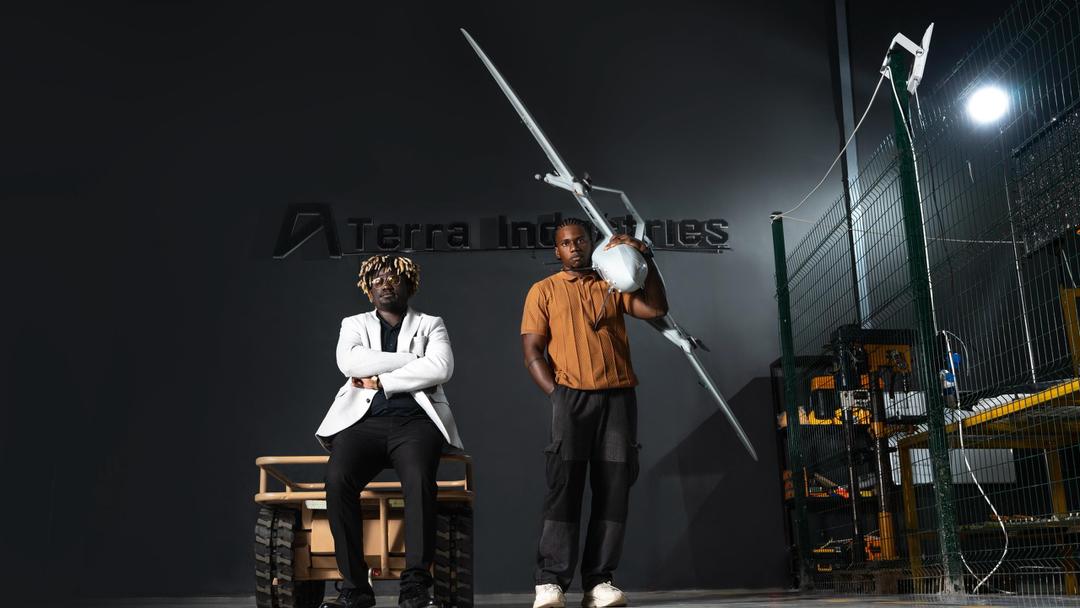
Five years after starting his edtech company, 22-year-old Nathan Nwachukwu realized that Africa was at a crossroads. The continent is undergoing rapid industrialization, he told TechCrunch. There's money, opportunity, and young, motivated people. He soon thought that the continent was on the “edge of an industrial revolution.”
“At the same time,” he said, he felt the continent was still struggling to address one of its biggest Achilles heels. “Terrorism and security instability.” Nwachukwu said Africa has more terrorism-related deaths than any other region in the world, and this problem could slow or stop the region's growth altogether.
He teamed up with his friend Maxwell Maduka, 24, to start Terra Industries, a defense company that designs infrastructure and autonomous systems to help governments and organizations monitor and respond to threats. The company announced Monday that it has come out of stealth with an $11.75 million round led by Joe Lonsdale's 8VC.
Other investors in the round include Valor Equity Partners, Lux Capital, SV Angel, and Nova Global. The company previously raised $800,000 in a pre-seed round, and Nwachukwu said other companies showed significant interest in the company after it appeared on CNN. African investors in the company include Tofino Capital, Kaleo Ventures and DFS Lab.
“Our goal is to create Africa's first defense prime, building autonomous defense systems and other systems to protect critical infrastructure and resources from armed attack,” said CEO Nwachukwu. Mr. Maduka serves as the company's CTO.
This team has a lot of military experience. 40% of the engineers served in the same role in the Nigerian Army. Alex Moore of 8VC, which specializes in defense investments, is also on the board, and Nigeria's Deputy Air Marshal Ayo Jolasinmi is an advisor. Maduka also served as an engineer in the Nigerian Navy and founded a drone company at the age of 19.
The company, based in Nigeria's capital Abuja, took a multi-domain approach to product development, looking at how to protect critical infrastructure from ground, water and air. For aviation, the company produces long-range and short-range drones. There are surveillance towers and ground drones on the ground. The company is still working on developing marine technologies that help protect infrastructure such as offshore rigs and underwater pipelines.
tech crunch event
San Francisco | October 13-15, 2026
Terra powers its technology with ArtemisOS, a proprietary software that collects, analyzes and synthesizes data in real-time. When a threat is detected, it alerts response forces (such as security agencies) so they can stop the threat. “We want to geofence all critical infrastructure and resources in Africa,” Nwachukwu said, adding that the problem is not a lack of firepower (many African militaries already have firepower).
Rather, it is a lack of sovereign information, as much of the information African countries rely on comes from Western countries, China and Russia.
“We want to put the defense of the continent's resources and infrastructure in Africa's own hands,” Nwachukwu continued. “We are the first truly pan-African defense company.”
Terra said it recently won its first federal contract but could not provide details. The company makes money when government and commercial customers order Terra systems and pay an annual fee for data processing and storage. Nwachukwu said the company has generated more than $2.5 million in commercial revenue to date and has protected assets worth about $11 billion.
Commercial income comes from protecting private infrastructure such as gold mines and power plants. Terra said most of its customers are from Nigeria, where it protects at least two hydropower plants and several small-scale mines.
The company hopes to use the new funding to expand and build defense factories across Africa. We also want to further expand our software capabilities and grow our AI team. The company will open software offices in San Francisco and London, but manufacturing will remain in Africa and the company said it will open more factories across Africa to foster job creation.
“It is clear that Africa today is experiencing what I see as an epic struggle for its very survival,” Nwachukwu said. “The only way to truly break out of the shackles that have held us back for the last 10 to 20 years is to make sure that we fully protect the continent's core resources, its core infrastructure.”